


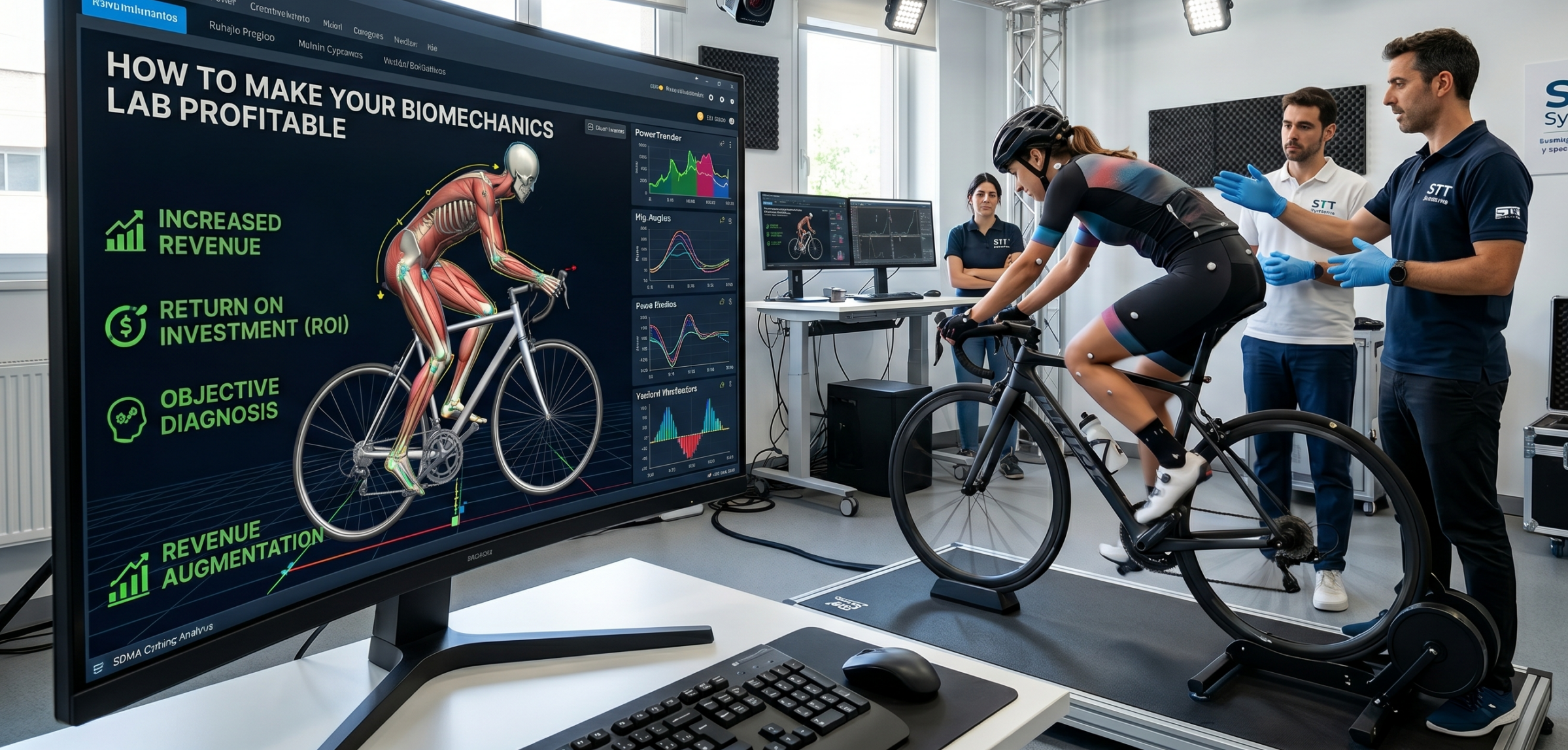
If you work in the fields of healthcare, biomechanics, podiatry, or sports performance, you already know that the market has changed dramatically in recent years. Today, success doesn’t necessarily go to those with the most years of experience on their resume. It goes to those who can demonstrate, quantify, and justify every clinical or technical decision with objective data.
And this is where we need to be blunt: if you aren’t measuring accurately, you’re at a competitive disadvantage.
However, there is a second reality that many professionals (physical therapists, podiatrists, sports medicine doctors, or biomechanists) discover too late: incorporating cutting-edge biomechanical technology does not magically guarantee profitability. What makes the difference is how you turn that technology into real revenue, market positioning, and authority in the eyes of your patients and competitors.
This comprehensive guide is designed to teach you how to transform your motion analysis lab into the core of your business model, preventing it from becoming an underutilized technological luxury. We’ll approach advanced biomechanics from a dual perspective: the high-level scientific rigor you demand and the strategic mindset your facility needs to grow.
The structural problem: good professionals, poor monetization
Many centers provide excellent clinical or technical care. They have highly qualified professionals who go above and beyond for their patients. However, they face a deep-seated structural problem that limits their growth and causes frustration:
- Undifferentiated services: To the average patient, your assessment session may seem identical to that of the clinic across the street that charges half as much.
- Reliance on subjective perception: If you evaluate a patient’s gait or an athlete’s movement based solely on your “clinical eye” or low-frame-rate 2D videos, you’re relying on your intuition. And intuition is hard to charge a premium for.
- Difficulty scaling: if each analysis requires hours of manual digitization, processing, and writing up in a text document, you face an insurmountable glass ceiling on your monthly revenue.
- Market-driven pricing: you get dragged into price wars because you lack a visual, objective tool to justify why your service is worth more.
- Clear translation: You’re providing a lot of value, but you’re not capturing it financially. You’re leaving money on the table.
Advanced quantitative biomechanics redefines the way expertise is delivered by translating clinical experience into clear, measurable and visually compelling data. It moves you from opinion-based assessment to evidence-based reporting that can be easily shared with patients, athletes, coaches and insurance providers.
From technical tool to strategic asset
A biomechanical analysis system shouldn’t be a secondary tool you use only in “complex cases” or when you have spare time. To be profitable, it should be the core of your business model.
When a motion capture system is implemented correctly, it not only improves your diagnostic capabilities but also transforms your business structure:
- It increases the perceived value of your services: patients see their own skeleton or 3D avatar moving in real time. The visual and psychological impact is undeniable.
- It allows you to justify premium pricing: you’re no longer selling a “consultation”; you’re selling a comprehensive biomechanical analysis with high-precision diagnostics.
- Reduces clinical uncertainty: you no longer have to wonder whether a certain degree of pronation is pathological or whether weight-bearing symmetry has returned to normal following surgery.
- Improves patient or athlete adherence: when people see their data and progress in clear graphs, they commit to the treatment until the end.
- It positions you as a leader in your field: you become the clinic or sports center to which others refer cases they cannot resolve.
And this has a direct consequence: higher revenue, better clients, and absolute competitive differentiation.
What you’re really buying (and the most common mistake)
The pattern of technological failure is surprisingly common: you buy the hardware, receive technical training on how to turn on the cameras, and then the equipment gets shelved because the workflow wasn’t adapted. The wrong question to ask is: What kinematic variables does this software provide? The right question is: What new service can I sell with this starting from week one?
When you invest in a high-end biomechanical system, it is a mistake to think that you are simply buying technology. The customer is not buying frames per second or passive sensors.
What you’re really buying is:
| Benefit | What changes | Impact |
|---|---|---|
| Increased perceived value | Real-time 3D visualization, providing immediate insight into the patient’s issue. | Differentiation and greater impact on the patient |
| Justification for premium pricing | You move from offering a standard consultation to a comprehensive biomechanical assessment with objective data. | Increase in average ticket size |
| Reduction in clinical uncertainty | Decisions based on data rather than subjective interpretation. | Greater clinical accuracy |
| Improved adherence | The patient sees their progress in clear metrics and graphs. | Greater patient engagement |
| Positioning as a leader | You become a center with advanced analytical capabilities. | More applications and leadership |
Smart diversification: how to maximise every euro invested
If you invest in clinical-grade and research biomechanical technology, you cannot afford to use it in just one niche. You need to apply it across the board to ensure a steady revenue stream.
High-performance and amateur sport
Here, the market is already educated. Amateur and professional athletes know that the details matter and are willing to pay for:
- Improving their technique and efficiency (gaining watts, improving pace per kilometre).
- Drastically reducing the risk of injury.
- Optimising their return to competition (Return to Play).
Services such as 3D bike fitting, running technique analysis and kinematic analysis of sporting movements are not only in extremely high demand, but also command high prices and offer predictable repeat business (pre-season assessments, mid-season adjustments, etc.).
Clinical setting (physiotherapy, podiatry and orthopaedics)
This is where something interesting happens: biomechanics reduces legal and medical uncertainty.
- Objectify progress: you can demonstrate with figures that range of motion (ROM) has improved by 15% in a month.
- Justify medical discharges: essential when dealing with insurance companies or medical referrals.
- Set yourself apart from other centres: objective evidence is your best selling point.
And that translates into something very concrete: absolute patient loyalty.
Prevention and workplace ergonomics
Prevention is a deeply undervalued economic goldmine. Companies of all sizes, amateur sports clubs and professional organisations are beginning to realise that preventing sick leave is infinitely cheaper than treating it. If you can measure risk by assessing sustained postures, tracking customisable KPIs or analysing repetitive lifting, you can sell high-value corporate prevention programmes.
Training, teaching and research
If you have precision technology, you have knowledge. And high-level knowledge can be monetised:
- Delivering weekend courses and workshops for other professionals.
- Paid collaborations with local universities for master’s degree placements.
- Publishing scientific papers that enhance the reputation (and fees) of your clinic.
The customer experience as a differentiating factor: service packaging
This is where business is won or lost. It is not enough to produce a flawless analysis; you must know how to present it. Your kinematic and kinetic data may be impeccable, but if the customer does not understand it, they will not value it.
Reports that are easy to understand
A good system allows you to translate extreme technical complexity (force vectors, Euler angles, multi-plane rotations) into visual clarity. The client needs to see a red or green traffic light, an avatar showing where the fault lies, and clear ‘before and after’ graphs.
Comprehensive services versus one-off sessions
An isolated analysis does not sell as well as a complete solution. You should change your business model by creating packages:
| Before | Now | Impact |
|---|---|---|
| Sports podiatry session | Comprehensive programme: 3D kinematic gait analysis + quantitative diagnosis + intervention + re-evaluation | Higher perceived value and premium positioning |
This dramatically increases the average spend and greatly improves the user experience, as patients feel they are investing in a structured process aimed at improving their health.
Optical vs. inertial: technology that impacts your bottom line
This is where we need to be very honest: not all biomechanical systems are designed to be profitable in every context. Some are extremely precise, but require so much preparation time that they erode your operating margin. Others are easy to use, but so limited in depth that they are of no use for research or complex clinical cases.
The key lies in striking the right balance and choosing the right architecture for your business model. STT Systems delivers technology that bridges rigorous scientific validation with commercial performance.
| Type of technology | The STT Systems solution | Strategic business impact |
|---|---|---|
| 3D optical systems | 3DMA (3D optical capture and analysis) | Accuracy that builds authority. It enables sub-millimetre-level analysis that takes your practice to the next level. Ideal for laboratories, advanced podiatry and research. When a patient enters a room equipped with high-speed cameras, you go from being ‘just another professional’ to being part of the elite. |
| Inertial measurement units (IMU) | ISEN (inertial motion) | True scalability. It allows you to take biomechanics out of the laboratory and onto the athletics track, the football pitch or the hospital ward. Shorter preparation times mean more patients assessed each day, more real-world context and growth without increasing fixed costs. |
| Portable optical systems | EDDO (portable optical capture) | Portability and versatility. If you require gold-standard optical precision but have multiple treatment rooms or work with external partners, EDDO eliminates the need for cables and complex fixed installations. Total flexibility for your day-to-day operations. |
Biomechanical use cases with immediate return
Let’s apply this to everyday clinical and sports practice. What can you start selling with these systems to generate a quick return?
Cycling and advanced bike fitting
Bike fitting can no longer rely on plumb lines or static measurements with a goniometer. Cyclists, who are customers with very high long-term value, seek to improve power transfer and eliminate lower back or knee pain. Using optical motion capture, clinicians and performance specialists can evaluate knee tracking, pelvic tilt and joint angles in real time, including under fatigue conditions.
- Impact: absolute customer loyalty. The customer will return every time they change their shoes, saddle or bike.
Runners, running technique and sports podiatry
Treating problems such as plantar fasciitis or tibial periostitis without measuring foot strike dynamics, overstriding, dynamic valgus or flight time is like tackling the problem blindly. Our software for the biomechanical analysis of runners automates the detection of risk patterns, enabling a more precise and objective assessment of running.
- Impact: creation of running rehabilitation packages and a massive influx of local triathletes and runners to your practice.
Golf: the precision of the kinetic chain
Golf demands perfect repetition. Analysing pelvic rotation versus thoracic rotation (Factor X) and the kinematic sequence is impossible to do with the naked eye. Objective data allows for the correction of minute technical flaws, which helps prevent back injuries and improves driving distance.
- Impact: access to a segment of clients with very high purchasing power who are willing to invest in ongoing programmes.
Tennis: power and joint protection
Analysing the tee shot or drive involves studying a complex kinetic chain that extends from the push-off of the foot to the internal rotation of the shoulder. Measuring these angular velocities prevents tendinopathies and rotator cuff tears.
- Impact: the opportunity to secure annual contracts with tennis academies to monitor their promising young players.
Clinical rehabilitation and motor control
For physiotherapists and orthopaedic surgeons, the return on investment comes from reduced risk. Measuring load symmetry following ACL surgery or assessing proprioceptive deficits using predefined protocols speeds up recovery and provides peace of mind for the patient.
- Impact: undeniable justification for prolonged treatments and high success rates that enhance the clinic’s reputation through word of mouth.
Functional assessment, frailty and active ageing
Identifying the risk of falls in older adults by measuring stride length, walking speed or the swing phase is a critical service in both the public and private healthcare sectors.
- Impact: access to tenders, agreements with care homes and public health programmes.
Operational optimisation and cost control: where profit margins are built
It is not enough to have cutting-edge technology; you must make it operationally profitable. If a biomechanical study takes you two hours to assess and three hours to generate a report, you are losing money, regardless of how much you charge.
Process efficiency
- Reduce data entry times: predefined protocols that guide the professional step by step.
- Automate analysis: the software calculates critical variables autonomously.
- Generate instant reports: customisable templates that can be exported in seconds with your logo and relevant graphs.
- The result is clear: more patients assessed in less time, without burnout.
Real control over costs and maintenance
If you don’t know how much time each scan takes, you don’t know what your profit margin is. A well-integrated system standardises processes and reduces variability. Furthermore, a system that is down due to a technical fault generates no revenue; that is why the robust reliability of our hardware and our rapid technical support are not an ‘extra’, but a business necessity to protect your profits.
Strategic partnerships: grow without risk
One of the smartest financial and commercial moves you can make when purchasing a biomechanical system is not to grow alone. Your technology makes you a magnet for other businesses.
- In the healthcare sector: partnering with physical therapy clinics that lack technology, hospitals, orthopedic surgeons, or health insurance providers gives you a steady stream of patients (volume) through referrals, in exchange for the objective reports they need for their practice.
- In the sports sector: track and field clubs, cycling teams, CrossFit boxes, or regional federations need what you offer to prevent injuries among their athletes. And they have a budget allocated to pay for it through preseason group evaluation agreements.
The power of the integrated ecosystem: total synchronization
Modern labs do not operate in information silos. Understanding kinematics (movement) is fundamental, but understanding kinetics (forces) and neuromuscular recruitment is what defines an elite researcher or clinician.
STT Systems stands out in the global market because our software is designed for native, frictionless integration. We synchronize our optical or inertial data to the millisecond with force platforms (to analyze joint moments and ground reaction forces), plantar and saddle pressure maps, heart rate sensors, high-speed color cameras…and with surface electromyography (sEMG) systems, such as the prestigious Trigno system from Delsys.
You don’t need to be a programmer to analyse this data. The system allows you to view the peak impact force, the delay in muscle activation and the exact joint angle at which they occur, all on a single screen and in real time. This saves countless hours of post-processing.
The STT Systems factor: the human touch in technology adoption
In the clinical and sports technology industry, many companies operate coldly: they sell expensive equipment, send a generic manual, and their technical support either disappears or hides behind an inefficient ticketing system.
We see the industry differently. We understand that, for you as a physiotherapist, coach, researcher or podiatrist, the initial learning curve can be demanding and even frustrating. That is why, at STT Systems, those who place their trust in us are not simply another customer in a database, but individuals whom we support with the utmost care, attention to detail and a warm, personal approach in every interaction.
Our approach is based on genuine and constant engagement throughout every stage of the project: from honest and thorough advice on whether your situation requires an optical or inertial system, through to installation, training in the use of the system and ongoing support designed to help you get the most out of it, both technically and financially, from day one.
We want you to feel supported. We know that if your workflow is agile, your business will grow, and we will be your long-term technology partner.
How to structure your work and metrics to progressively improve ROI
To ensure your system becomes a profit-generating machine, we propose this structured framework:
| Phase | Objective | Key actions | Enfoque |
|---|---|---|---|
| Phase 1 (Months 0–1) | Start-up and validation | – 1–2 key services (e.g. corridor) – Fixed protocol: 30–45 mins – Pricing based on clinical value | Rapid roll-out and positioning |
| Phase 2 (Months 2–3) | Optimisation | – Integrar EMG y plataformas – Informe en <5 min – Casos reales anonimizados | Efficiency and trust |
| Phase 3 (Months 4–12) | Scaling | – Partnerships with clubs and companies – Use in teaching and research – Applied training | Growth and expansion |
Measure What Matters (KPIs)
Track your revenue from biomechanical sessions, the average end-to-end time per patient, the conversion rate from diagnosis to long-term treatment, and the profit margin per report issued on a monthly basis. If these numbers are growing, the strategy is working.
Position Yourself or Fall Behind
The healthcare, podiatry, and sports performance sectors are inexorably evolving toward objectivity. Increasingly, patients, athletes, and insurers demand evidence, value sub-millimeter precision, and are willing to reward centers that stand out from the crowd with their loyalty and money.
The question is no longer whether your clinical or sports center will incorporate advanced biomechanics to survive in today’s market. The question is when… and how you will do it.
Because professionals and clinics that are already integrating systems like 3DMA, ISEN, or EDDO aren’t just radically improving their daily practice and reducing human error; they’re building stronger, more profitable, and more efficient businesses that project an authority their competitors simply can’t match.
Take the strategic step today
If you’re considering making this technological leap and want to do so with a clear vision of profitability, with personalized support focused on the real growth of your business, the next move makes perfect sense.
It’s not about buying boxes and cables. It’s about building the technical infrastructure that allows you to grow with accurate data, impeccable clinical judgment… and real revenue.
Financial viability and return on investment analysis: from investment to net profit
After breaking down the clinical and strategic value of advanced biomechanics, it is essential to ground the technology in financial terms. Below, we present a projected analysis based on a standard 3DMA configuration for cycling and bike fitting. These figures demonstrate that, with consistent operational management, the system ceases to be a cost and becomes a highly profitable asset in a surprisingly short period of time, allowing you to capture the economic value of your specialized knowledge.
Financial assumptions for the 3DMA system
| Concept | Estimated Value |
|---|---|
| Initial Investment (Retail Price of Cycling System) | 14.000 € – 15.000 € |
| Selling Price per Session (Retail Price of 3D Fitting) | 250 € |
| Number of sessions to break even | 55 – 60 fittings |
Return on Investment (ROI) Scenarios
| Scenario | Weekly volume | Weeks to ROI | Estimated duration (months) |
|---|---|---|---|
| Optimistic (intense pace / leading center) | 4–6 sessions | 10–14 weeks | ~3 months |
| Moderate (standard pace / clinical launch) | 2–4 sessions | 25–30 weeks | ~7 months |
| Conservative (minimal activity) | 1–2 sessions | 30–60 weeks | ~ 12 months |
Here is the proposed closing for the document, maintaining the professional and technical tone we’ve established and adhering to Spanish spelling conventions (avoiding unnecessary capitalization in headings).
Transform your professional practice today
Technology alone represents potential; strategy is what generates real returns. If you’re ready to raise the bar for your practice, set yourself apart from the competition with objective evidence, and build a solid, scalable business unit, the next step is to see the system in action within your own context.
It’s not just about acquiring a tool, but about implementing a revenue multiplier. We invite you to request a personalized demo where our technical team will show you how to integrate these solutions into your daily workflow and answer any questions you may have about technical or financial operations.
Request a personalized demo
Click the link and take the leap: Request a STT Systems demo