


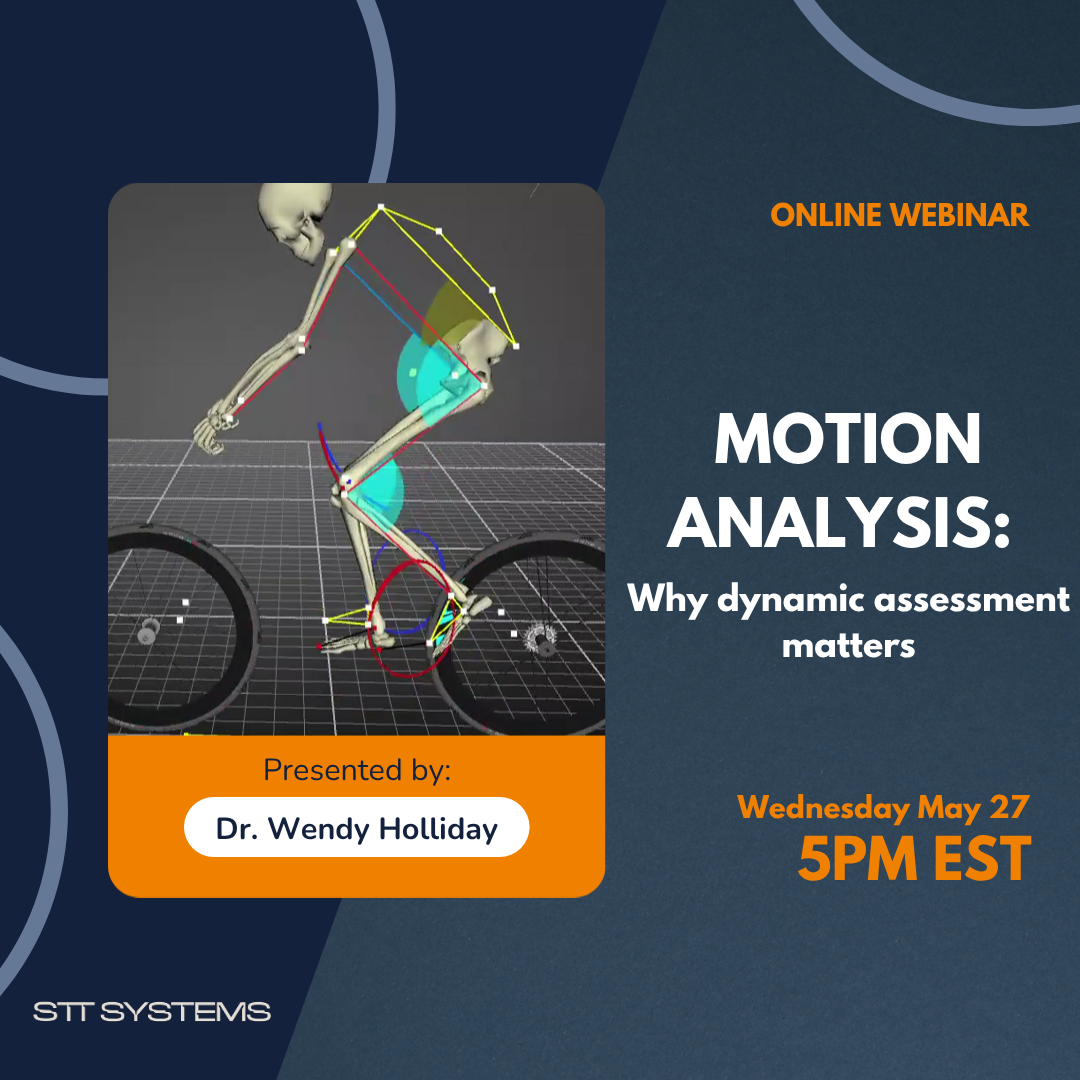
A recent webinar in collaboration with Dr Wendy Holliday from WHBikeFit explored a key topic in cycling biomechanics: why dynamic motion analysis makes a difference in modern bike fitting.
Dr Wendy Holliday is a physiotherapist, Doctor of Exercise Science and a specialist in cycling biomechanics. She completed her BSc in Physiotherapy at the University of Cape Town in 2006 and, after several years of clinical experience, began her doctoral studies in 2014, focusing on the optimisation of cycling biomechanics.
Her doctoral research explores how intrinsic rider factors, performance and kinematics influence the optimisation of cycling position. In particular, her work examines the validity of measurement tools used in bike fitting, the role of flexibility and anthropometric characteristics in individual bicycle setup, and how body position, muscle activity and saddle pressure change with increasing cycling intensity.
The findings of her thesis provide particularly relevant insights for clinical practice and evidence-based bike fitting:
- Flexibility and anthropometrics directly influence optimal rider position and performance.
- Kinematics, muscle activity and saddle pressure distribution depend on workload.
- Bike fitting measurement methods are reliable, but static and dynamic measures are not interchangeable.
In this regard, their research reinforces a key point: pedalling intensity is a determining factor in bike fitting, as it influences the rider’s position, muscle activation and comfort.
Throughout her career, she has worked with cyclists of all levels, from recreational riders to some of South Africa’s top mountain bikers and triathletes, as well as collaborating with WorldTour teams such as UAE Team Emirates. Her multidisciplinary approach combines physiotherapy, research and applied biomechanics, working alongside medical doctors, coaches and other performance professionals.
What was covered in the webinar?
The evidence behind static vs dynamic assessment
The scientific foundations were reviewed to explain why a static riding position does not always reflect the cyclist’s real behaviour on the bike. Although static assessment remains a useful tool, movement provides additional essential information to fully understand pedalling mechanics.
How pedalling intensity modifies kinematics
Dr Holliday demonstrated how movement patterns change as workload or intensity increases, which is essential for accurate biomechanical fitting. The position observed during light pedalling can differ significantly from that adopted during high-intensity training or competitive scenarios.
The case for dynamic analysis in cycling
The benefits of assessing cyclists in motion were discussed in order to optimise performance, comfort and injury prevention. Dynamic assessment helps identify patterns that may go unnoticed during traditional static evaluation and supports more objective decision-making.
The role of the 3DMA system
During the session, our 3DMA system was used, a 3D motion capture solution designed for biomechanical analysis in sport and clinical applications. Thanks to its ability to record movement in real time, the system provides objective data on pedalling mechanics and supports more precise fitting decisions.
Why is this approach important?
In bike fitting, small variations in technique or workload can lead to significant changes in rider position. Dynamic analysis allows professionals to:
- Detect compensations that are not visible in static assessment
- Understand how the body responds under different intensities
- Personalise fitting more effectively for each cyclist
- Complement professional expertise with objective biomechanical data
- Improve decision-making in performance optimisation and injury prevention
Thank you for the collaboration
We would like to thank Dr Wendy Holliday for sharing her clinical, research and professional expertise with the international community of bike fitting, physiotherapy and cycling biomechanics specialists.
Her work demonstrates how the integration of scientific research, clinical experience and advanced motion analysis technologies enables increasingly precise and personalised assessments for cyclists.
For professionals working in motion analysis, bike fitting or sports performance, this data-driven approach is becoming increasingly essential to deliver more comprehensive and accurate evaluations.