


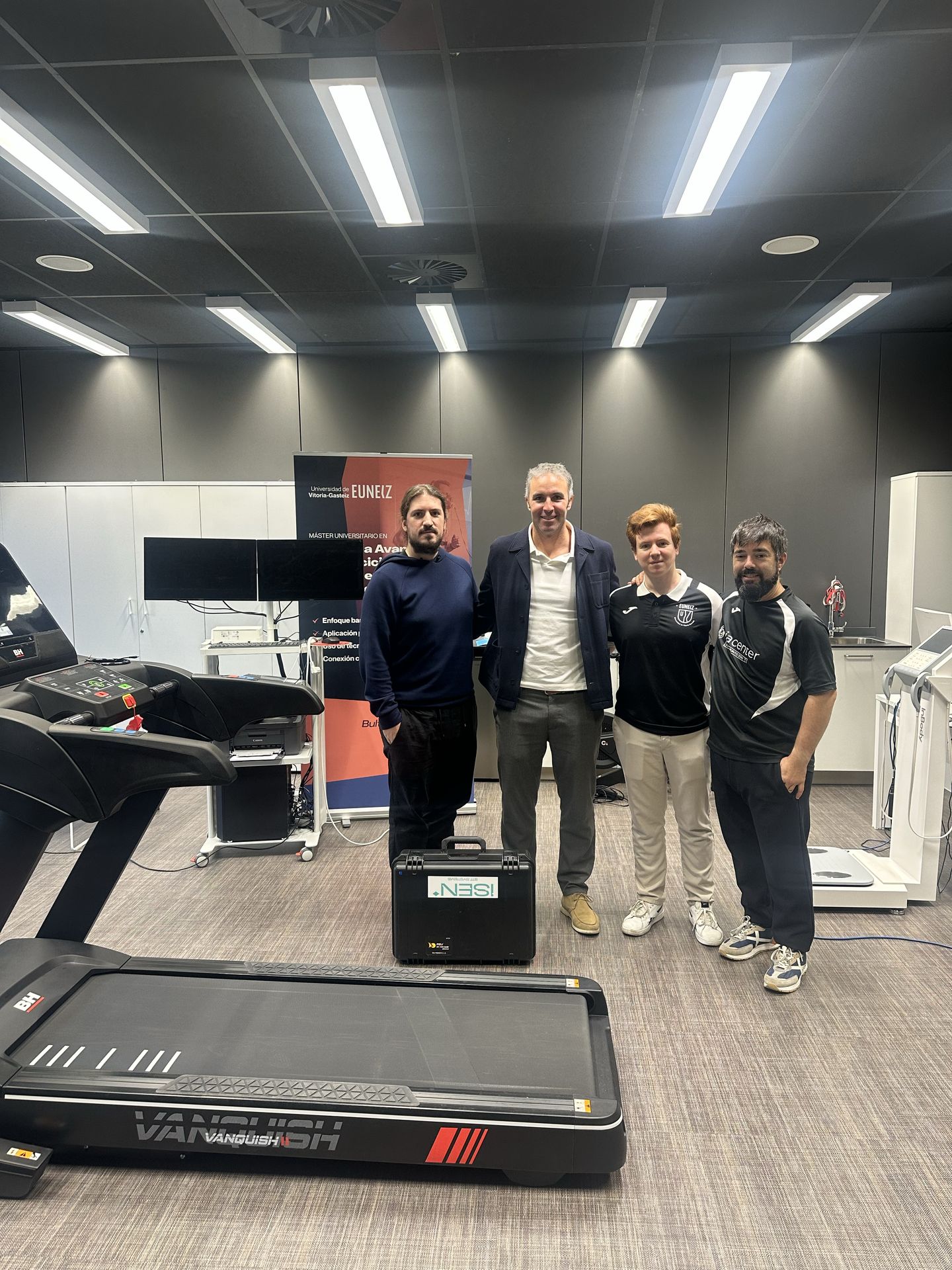
STT Systems has held a demonstration of its motion analysis solutions at EUNEIZ, the University of Vitoria-Gasteiz, to showcase the capabilities of 2DMA in the biomechanical study of walking and running, as well as the applications of the iSen inertial sensor systems.
During the session, walking and running tests were carried out on a treadmill, using a single-camera 2DMA system. The demonstration provided an overview of the software’s main features and showed how motion analysis technology can be integrated into teaching, research and practical training activities at university level.
Biomechanical analysis of walking and running
Throughout the demonstration, various 2DMA tools for the analysis of human movement were presented:
- System calibration and preparation of recordings.
- Recording and analysis of movement.
- Editing ranges to define and study different phases of movement
- Generating reports with the results obtained.
- Creating notes to document observations.
- Comparing recordings to analyse differences between movements.
These features enable the study of movement from an objective and visual perspective, facilitating the analysis of biomechanical parameters and the monitoring of different movement patterns.
Applications in physiotherapy, sports science and podiatry
Gait and running analysis has applications in various disciplines related to human movement.
In physiotherapy, biomechanical analysis enables the study of walking and running patterns, the observation of joint movement and the collection of objective information for functional assessment.
In sports and health sciences, these tools facilitate the study of running technique, the mechanics of movement and the differences between various performance styles.
In podiatry, gait and running analysis provides visual information relevant to the study of movement and its relationship with lower limb function.
Technology for teaching and research
The visit also provided an opportunity to showcase the capabilities of iSen inertial sensors, expanding the range of technological options available for human motion analysis.
The demonstration took a hands-on approach, with positive feedback regarding the ease of use, clarity and direct applicability of the tools presented.
We continue to bring our motion capture and analysis solutions to universities and research centres, demonstrating how technology can contribute to education, research and knowledge in the field of human biomechanics.
Thank you to the team at EUNEIZ for their time and for the opportunity to share this session.