


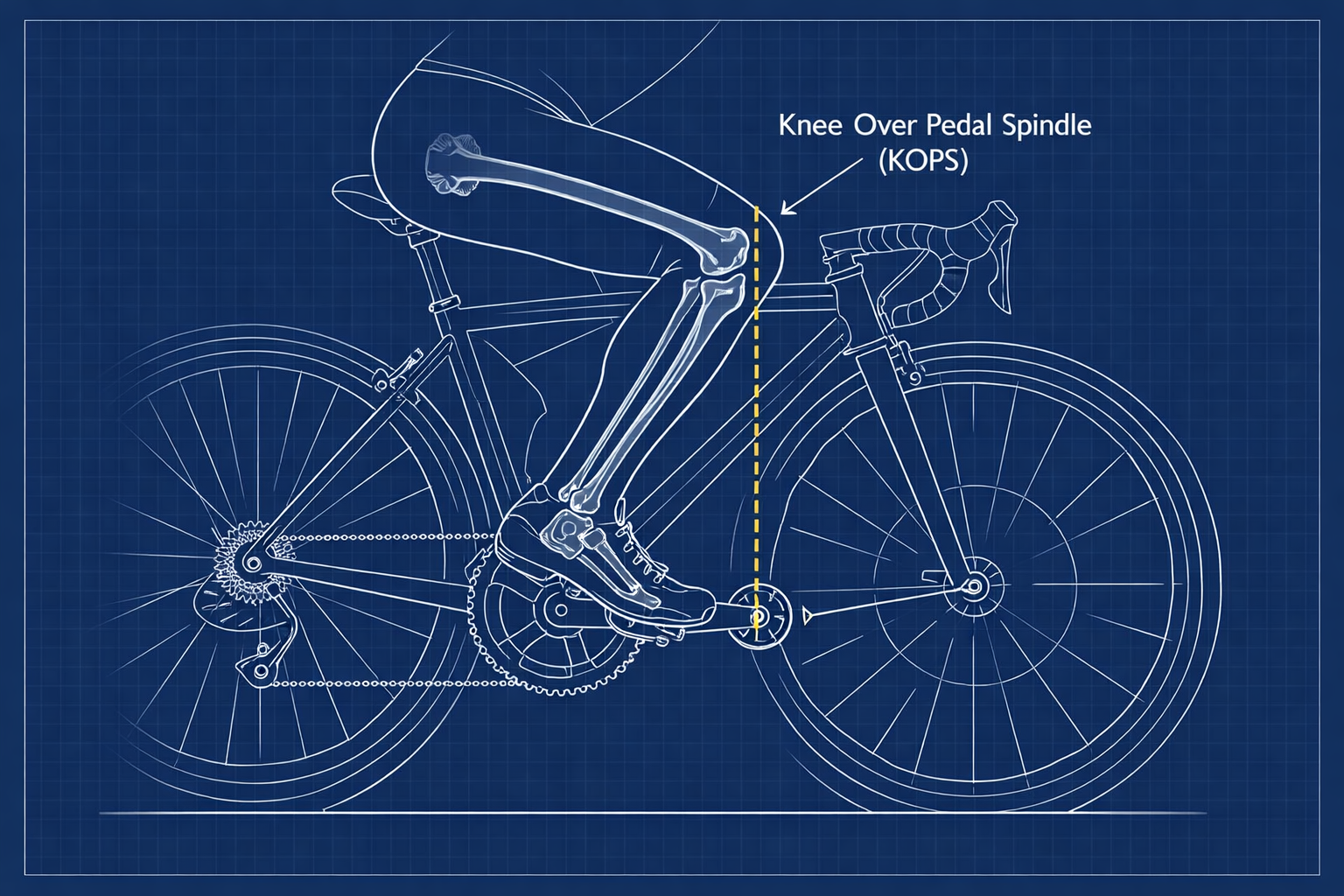
In bike fitting, the KOPS (Knee Over Pedal Spindle), also known as the plumb line method, has been a classic reference point for decades. Its premise was simple: align the kneecap directly over the pedal axle when the crank arm is in the forward horizontal position (crank at 90 degrees), aiming for an alignment that in theory optimized power transfer and mechanical efficiency.
This technique gained popularity thanks to its simplicity and ease of use. With basic tools such as a plumb line or simple video analysis, technicians and cyclists could quickly adjust the saddle’s horizontal position without the need for advanced measurement systems. For recreational riders or beginners, KOPS provided an objective and reproducible reference, becoming a cornerstone of initial fittings.
However, time and the evolution of modern biomechanics have revealed its limitations. Today we know that the optimal saddle position depends not only on a vertical line between the knee and pedal, but on a set of individual factors: the femur-to-tibia ratio, pelvic mobility, pedaling technique, and rider goals. A purely mechanical application of KOPS can be insufficient or even counterproductive in some cases.
KOPS still holds value as a quick reference or starting point, but relying solely on it no longer reflects the functional complexity of pedaling. Modern biomechanics encourages looking beyond the plumb line. Each saddle adjustment should consider movement, force, muscle activation, and individual characteristics to achieve efficiency, comfort, and injury prevention.
What Is the KOPS Method?
The KOPS method is based on a simple principle: aligning the kneecap with the pedal axle when the crank is horizontal, with the front pedal at 3 o’clock and the rear at 9 o’clock. Traditionally, this is assessed using a plumb line dropped from the kneecap. If it falls directly over the pedal axle, the position is considered optimal.
The goal is to maximize mechanical efficiency by minimizing horizontal forces and optimizing power transfer. In theory, this alignment allows the leg’s flexors and extensors to work more directly and efficiently, avoiding unnecessary muscular overload.
How the KOPS Method Works
The principle is intuitive. With the crank arms at 3 and 9 o’clock, a plumb line is drawn from the kneecap. If the vertical line falls over the pedal axle, the saddle is considered correctly positioned horizontally.
The reasoning is biomechanical. Placing the knee over the axle minimizes horizontal force and maximizes the vertical component, transmitting power directly to the pedal. In theory, this should reduce overloads and improve mechanical efficiency.
Why It Became Popular
- Easy to measure because it requires no advanced equipment.
- Quick to apply, useful in initial fittings or for recreational cyclists.
- Reproducible reference, allowing before-and-after comparisons.
- Despite its initial utility, KOPS is a static evaluation. It does not reflect the real dynamics of pedaling or individual differences among cyclists.
Biomechanical Limitations of the KOPS Method
Modern research in cycling biomechanics has shown clear limitations of KOPS:
- It does not consider individual variability. Cyclists differ in femur and tibia length, pelvic mobility, and joint flexibility.
- It is a static evaluation. Pedaling is a dynamic movement, and a fixed position does not represent efficiency throughout the pedal stroke.
- It ignores pedaling technique. Muscle activation, hip angle, and torso orientation all influence force transmission.
- It overlooks individual goals. Performance, comfort, injury prevention, and cycling discipline are not represented by a simple plumb line.
Practical Examples of Its Limitations
- Saddle too far back: the plumb line falls behind the pedal axle, increasing horizontal force, lumbar overload, and reducing efficiency.
- Saddle too far forward: the plumb line falls in front of the pedal axle, increasing the risk of patellofemoral compression and quadriceps overload.
These examples show that a purely mechanical application of KOPS does not always match the most ergonomic or efficient position for each cyclist.
Insufficient Mechanical Basis
Some proponents claim that aligning the knee with the pedal axle optimizes leg muscle use. Current science shows otherwise:
- Pedal force is cyclical and multidirectional, not static.
- Pedaling mechanics depend on hip, trunk, knee, and ankle angles, as well as sequential muscle activation.
- A static snapshot of the knee over the axle does not guarantee efficiency or injury prevention.
KOPS oversimplifies a complex process, limiting its usefulness as a standalone criterion.
Modern Alternatives and Individualized Approaches
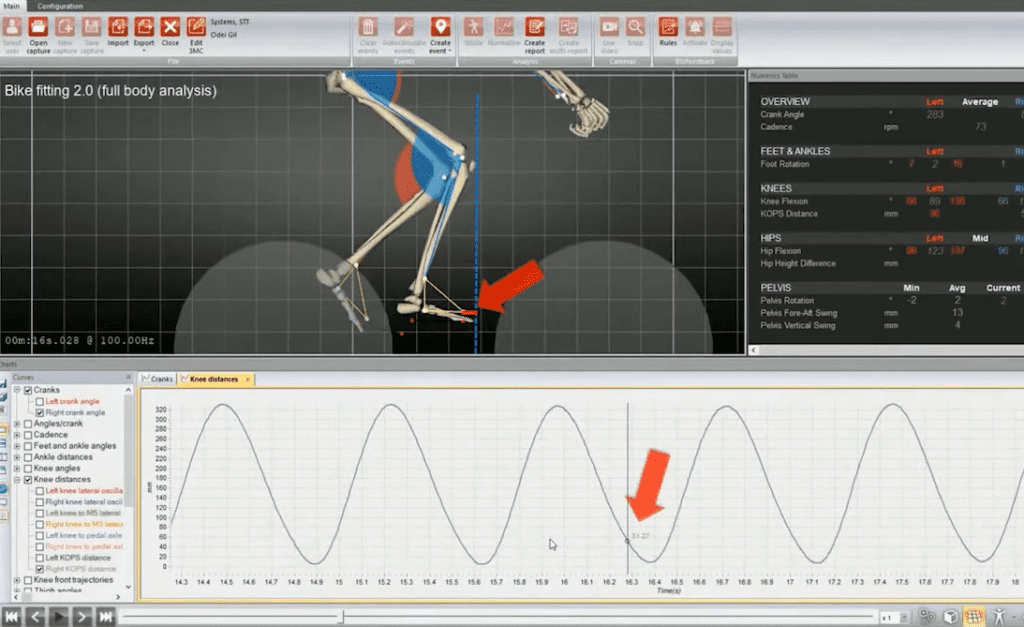
Contemporary bike fitting has evolved toward a data-driven, individualized approach. Key technologies include:
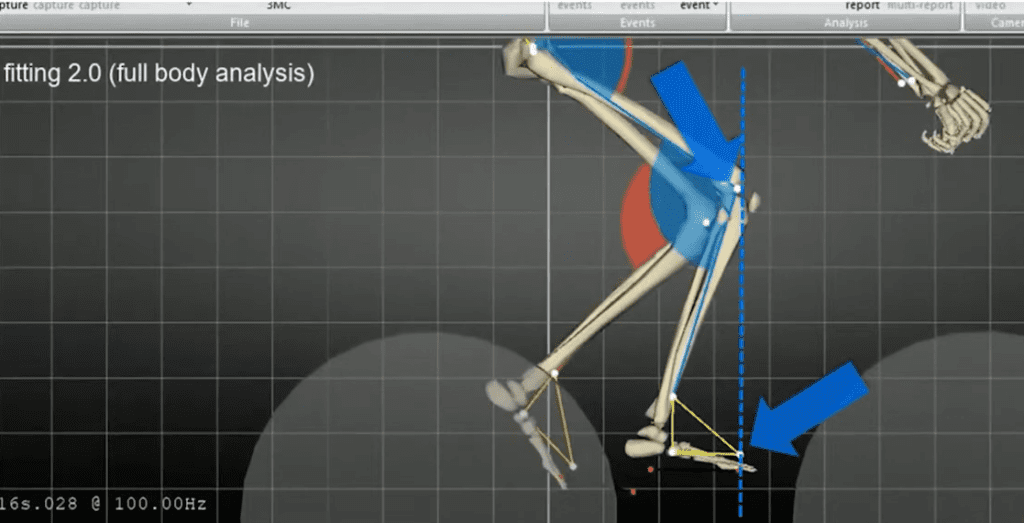
- 3D motion capture to analyze full joint trajectories.
- Electromyography (EMG) to identify muscle activation during pedaling.
- Real-time power and torque measurement to optimize force transfer.
Factors to Consider in Horizontal Saddle Adjustment Today
- Body proportions, including femur and tibia lengths and joint mobility.
- Center of gravity and weight distribution, affecting stability and comfort.
- Neuromuscular efficiency for optimized muscle activation.
- Individual goals, including performance, comfort, and injury prevention.
- Cycling discipline, such as road, MTB, triathlon, or track.
- Requirements and experience: Kilometres per year.
- Musculoskeletal flexibility.
Even alternative methods like Keith Bontrager’s center-of-gravity approach show controversy, as theory does not always translate into real comfort or energy savings.
Does the KOPS Method Still Make Sense?
KOPS is not entirely obsolete. It can serve as a preliminary tool or quick reference for:
- Initial adjustments for beginner cyclists.
- Quick checks against extreme setups.
- Comparing changes before and after a more complete fit.
However, in advanced analysis, KOPS is not enough. The saddle’s horizontal position should be evaluated within a dynamic system that considers movement, force, and individual anatomy.
KOPS Compared with Modern Bike Fitting
| Aspect | KOPS | Modern Bike Fitting |
| Evaluation | Static | Dynamic, in motion |
| Individualization | Low | High, tailored to each rider |
| Tools | Plumb line, visual observation | 3D motion capture, EMG, power meters, VO2Max testing |
| Objectives | Basic mechanical efficiency | Performance, comfort, injury prevention, technique |
| Limitations | Ignores body proportions and pedaling technique | Integrates biomechanics, forces, and rider goals |
The KOPS Method in Perspective
The KOPS method has historical and educational value, but its role as a definitive standard has been surpassed. Modern biomechanics shows that the optimal saddle position is multifactorial, depending on the rider’s morphology, technique, goals, and cycling discipline.
Today, KOPS can be an initial reference, but advanced fitting requires analyzing the cyclist in motion, measuring forces, and adapting the bike to real needs. Pedaling biomechanics has moved beyond the static view of the knee over the axle. Saddle fore-aft adjustment should be seen as just one variable within a dynamic and interdependent system.
In short, knowing the KOPS method is important, but applying it exclusively is not. The future of bike fitting is individualized, precise, and data-driven.
If you want to take your bike fitting to the next level, combine the classic KOPS experience with modern biomechanical analysis tools. Fit your bike to your body and pedaling style, and maximize both performance and comfort on every ride.
Contact us today and let us show you how modern bike fitting and biomechanical analysis can help you optimize your clients’ performance, comfort, and injury prevention. Discover the tools and expertise that make a real difference in your professional practice.